


 Français
 English GB
Rain Chains and On-Site Stormwater Management
Elegant, visible and functional, a rain chain can create a connection between the roof, the garden and a more natural approach to managing rainwater.
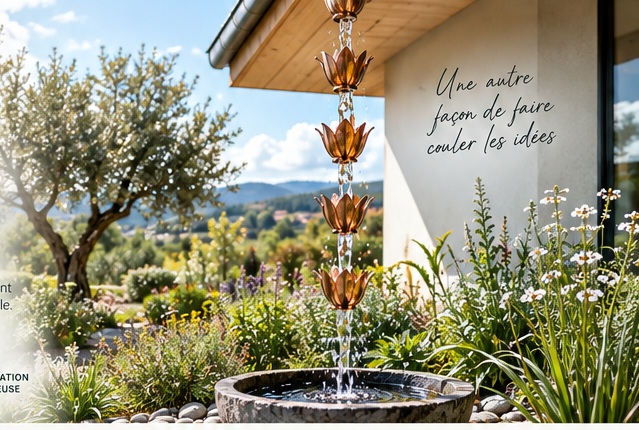
A rain chain is often chosen to replace a conventional downspout and add a decorative touch to a building facade. But it can also form part of a broader approach: managing stormwater directly on the property.
Important: a rain chain is not, by itself, a stormwater management system. It can, however, provide the first visible link between the roof and a suitable infiltration, rainwater harvesting or landscaping solution.
What Is On-Site Stormwater Management?
On-site stormwater management means managing some or all of the rainwater where it falls, rather than systematically channelling it away as quickly as possible into a public drainage network.
Depending on the characteristics of the property, several approaches may be considered: ground infiltration, rain gardens, vegetated swales, drainage beds, basins, temporary storage or rainwater harvesting.
This approach helps bring stormwater management closer to the natural water cycle and, where ground conditions permit, encourages water to soak into the soil near where it falls.
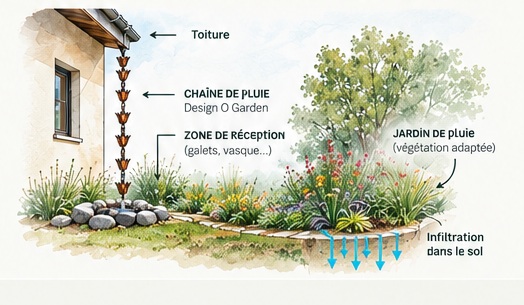

Rain Chains: Making the Path of Water Visible
A rain chain replaces all or part of a conventional vertical downspout and guides roof runoff through a series of cups or linked elements.
Unlike a traditional downspout, which is designed primarily to be unobtrusive, a rain chain makes the movement of water visible.
Flowing water, light, movement and sound become part of the architecture and the garden itself.
Copper can naturally develop a patina over time, while aluminium allows for lightweight, durable and contemporary designs.
A Connection Between Architecture and Landscape
A rain chain can create a visible link between the roof and the landscaping feature designed to receive or make use of the water.
Where Can a Rain Chain Direct Water?
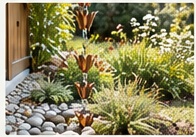
Into a Rain Garden
A planted, shallow depression designed to temporarily collect rainwater and help manage it on site.

Into a Vegetated Swale
A landscaped channel that helps slow, guide and temporarily hold stormwater.
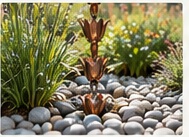
Into an Infiltration Area
Pebbles, drainage beds and permeable surfaces can all help spread and manage the water.
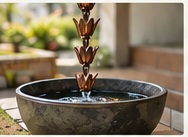
Into a Decorative Bowl or Basin
Collecting rainwater can itself become an attractive feature in the garden.
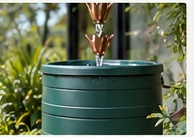
Into a Rainwater Harvesting System
Water from the roof can be directed into a suitable collection system.
What Are the Benefits for Your Property?
Reduce Surface Runoff
Managing rainwater closer to where it falls can help reduce its rapid movement across impermeable surfaces.
Encourage Infiltration
Where ground conditions allow, some of the rainwater can gradually soak into the soil.
Make Use of Rainwater Locally
Rainwater can be collected, infiltrated or used to supply a suitably designed landscaping feature.
Create a Living Landscape
Swales, basins, rain gardens and planting can help incorporate rainwater into the garden's design.
The Couronnières 2 Business Park
In Liré, Mauges Communauté presents the Couronnières 2 business park as a development that incorporates on-site stormwater management.
Each plot is designed to manage rainwater locally, complemented by features such as vegetated swales and permeable reservoir road structures.
According to Mauges Communauté, the system is designed to manage up to this volume, with an overflow provided for exceptional rainfall events.
A rain chain can then provide the visible connection between the roof and the ground-level stormwater management system.
Which Rain Chain Is Suitable for Different Water Flows?
Not all rain chains perform in the same way when exposed to varying water volumes, wind or heavy rainfall.
Cup-style rain chains generally help channel water more effectively. Large-diameter cups are particularly useful when significant amounts of rainwater flow from the roof.
Linked or ring-style rain chains offer a striking visual appearance, but may create more splashing as water flow or wind increases.
Can You Collect Rainwater from a Rain Chain?
Yes. A rain chain can guide roof runoff into a suitably designed tank, basin or rainwater collection system.
It replaces the visible vertical section of the downspout while providing an attractive solution.
However, the collection system must be sized for the amount of water it may receive and fitted with an appropriately sized overflow.
Essential Considerations
Stormwater management must always be adapted to the specific site.
System sizing depends on factors including roof area, rainfall intensity, slope, soil type and infiltration capacity.
Local authorities may also impose specific requirements for stormwater discharge or infiltration.
For major installations or complex site conditions, it is advisable to have the system assessed by a qualified professional.
Rain Chains and Stormwater Management
Can a rain chain replace a conventional downspout?
Yes. In many situations, it can replace the vertical section of a downspout. The model must, however, be suited to the water flow, wind exposure and receiving system.
Can a rain chain direct water into a rain garden?
Yes. It can guide water towards a suitably sized receiving area, swale or rain garden.
Will a rain chain work during heavy rainfall?
Yes, but different models offer different water-guiding capacities. Large-cup designs are generally better suited to higher flows.
Can a rain chain be connected to a rainwater harvesting system?
Yes, provided the inlet, storage capacity and overflow are properly sized.
What is a rain garden?
A rain garden is a planted, usually shallow sunken area designed to temporarily receive rainwater and help manage it directly on the property.
Make Rainfall Part of Your Outdoor Space
Discover Design O Garden rain chains and imagine a more beautiful way to guide rainwater from your roof to your garden.
Explore Our Rain ChainsThis page draws in particular on resources from Cerema concerning integrated stormwater management and rain gardens, as well as the Couronnières 2 business park example presented by Mauges Communauté.